...some vintage 80's windsurfing press:
Thursday, August 5, 2010

Wednesday, August 4, 2010
feedback from an "old dog"
Jeff:
That one shot of you with another wave outside is epic. You crack me up. No sooner do you become a stand-up paddle board guy than you start redesigning the paddles. You creative guys are the greatest, otherwise I'd still be surfing a redwood plank with no skag. When I first started surfing, balsa boards were still common, although foam was becoming dominant. I could still live with an old balsa board but I couldn't live without my wetsuit and surf leash. When I did most of my surfing, from the late 50s to the mid-60s, no one had a surf leash and only a very few had a wetsuit and then it was only a top, designed for scuba diving. I surfed all the winter spots in 52-54 degree water. We would lose our boards regularly and that meant a long swim through ice water and then a rock dance to retrieve a damaged board. I continued paddling out, though, because the surf stoke was at the max. Of course, after an hour I couldn't feel the bottom of my feet on the board, pull my fingers together to paddle, or even talk. None of us had ever heard the word hypothermia but we were in its grips. We did, though, have fires going on the beach. When I started surfing again in 1989, I found that I loved my wetsuit and my surf leash--my only concessions to modern times. You know that I only get out about a half dozen times a year. If we had 75-78 degree water, I'd probably be a regular. Our cold water simply seems brutal now at my decrepit 63 years of age. The only thing golden about these years is my mortgage has been retired. I'll attach a few shots of County Line. I got out two times this winter. That was plenty.


 Roger McGrath
That one shot of you with another wave outside is epic. You crack me up. No sooner do you become a stand-up paddle board guy than you start redesigning the paddles. You creative guys are the greatest, otherwise I'd still be surfing a redwood plank with no skag. When I first started surfing, balsa boards were still common, although foam was becoming dominant. I could still live with an old balsa board but I couldn't live without my wetsuit and surf leash. When I did most of my surfing, from the late 50s to the mid-60s, no one had a surf leash and only a very few had a wetsuit and then it was only a top, designed for scuba diving. I surfed all the winter spots in 52-54 degree water. We would lose our boards regularly and that meant a long swim through ice water and then a rock dance to retrieve a damaged board. I continued paddling out, though, because the surf stoke was at the max. Of course, after an hour I couldn't feel the bottom of my feet on the board, pull my fingers together to paddle, or even talk. None of us had ever heard the word hypothermia but we were in its grips. We did, though, have fires going on the beach. When I started surfing again in 1989, I found that I loved my wetsuit and my surf leash--my only concessions to modern times. You know that I only get out about a half dozen times a year. If we had 75-78 degree water, I'd probably be a regular. Our cold water simply seems brutal now at my decrepit 63 years of age. The only thing golden about these years is my mortgage has been retired. I'll attach a few shots of County Line. I got out two times this winter. That was plenty.
Tuesday, August 3, 2010
WALLALLAW: Rolling Saucer
WALLALLAW: rolling saucer
Based on the concept of a frisbee rolling along the beach on a windy day...assymetical 3 meter wheel, based on the same proportions as a frisbee... acts as a rolling sail that you ride... independent 2 meter long "gunbana" wheeled board tracks along flat interior rim of saucer... "volant" boom spins freely in the open 1 meter center section of the invention, allowing rider to change pitch/yaw/direction or brake (which lets rider "loop" with the big wheel)... 4 removable flat panels allow surface area to change from 3.5 square meters to 6.5 square meters to adapt to wind conditions... large diameter of the wheel effortlessly rolls over uneven terrain!
construction: thermoformed PVC foam core sandwiched with multiple layers of vacuum bagged triaxial weave fiberglass cloth & polyester resin, carbon fiber spokes, sealed precision bearings, urethane wheels, natural rubber skin along exterior of wheel.
Invention/collaboration between Eric LeDean & Jeff Casper through Les Ateliers / E.N.S.C.I. (Ecole Nationale Superiure de Creation Industrielle), Paris, France. Testing of prototype by Jeff Casper on the coast of Brittany, France. Video shot & edited by Fred Tevlon.
copyright 1989
Based on the concept of a frisbee rolling along the beach on a windy day...assymetical 3 meter wheel, based on the same proportions as a frisbee... acts as a rolling sail that you ride... independent 2 meter long "gunbana" wheeled board tracks along flat interior rim of saucer... "volant" boom spins freely in the open 1 meter center section of the invention, allowing rider to change pitch/yaw/direction or brake (which lets rider "loop" with the big wheel)... 4 removable flat panels allow surface area to change from 3.5 square meters to 6.5 square meters to adapt to wind conditions... large diameter of the wheel effortlessly rolls over uneven terrain!
construction: thermoformed PVC foam core sandwiched with multiple layers of vacuum bagged triaxial weave fiberglass cloth & polyester resin, carbon fiber spokes, sealed precision bearings, urethane wheels, natural rubber skin along exterior of wheel.
Invention/collaboration between Eric LeDean & Jeff Casper through Les Ateliers / E.N.S.C.I. (Ecole Nationale Superiure de Creation Industrielle), Paris, France. Testing of prototype by Jeff Casper on the coast of Brittany, France. Video shot & edited by Fred Tevlon.
copyright 1989
VIDEO: resin infusion
This video documents/demonstrates the process of "vacuum resin infusion". It is such an interesting, clean technique for lamination of composites. Initially it was used in the aerospace industry, but more recently has been the method of choice to fabricate large-scale windmill turbine blades as well as giant ultralight boat hulls or other applications requiring a state-of-the-art ratio of reinforcement fiber to resin. There is little waste or noxious odors with this process & the efficiency of the saturation is much higher than hand lamination combined with vacuum bagging.
I recently used this process to create an involute-curved windmill vane for a vertical-axis windmill of my own design. It was a unique achievement & differs from what's been done to date for several reasons. The vanes were built using all natural materials... there is no glass fiber, carbon fiber, kevlar or any other exotic, energy intensive material used... it is a flexible, durable monocoque construction combining a FSC certified plywood sub-frame base with reclaimed/remilled redwood "battens"... this wood core is sandwiched between two layers of hand-dyed 5 oz. hemp/silk cloth. The tinted bioresin used to infuse these components is called SuperSap, a sustainable epoxy created from the waste stream of the paper industry (pine trees) & the biofuel industry (rapeseed). The flywheel/turntable windmill will be mounted in the "crow's nest" of a treehouse I helped build which is located in a mammouth fig tree in Santa Monica, CA.
I recently used this process to create an involute-curved windmill vane for a vertical-axis windmill of my own design. It was a unique achievement & differs from what's been done to date for several reasons. The vanes were built using all natural materials... there is no glass fiber, carbon fiber, kevlar or any other exotic, energy intensive material used... it is a flexible, durable monocoque construction combining a FSC certified plywood sub-frame base with reclaimed/remilled redwood "battens"... this wood core is sandwiched between two layers of hand-dyed 5 oz. hemp/silk cloth. The tinted bioresin used to infuse these components is called SuperSap, a sustainable epoxy created from the waste stream of the paper industry (pine trees) & the biofuel industry (rapeseed). The flywheel/turntable windmill will be mounted in the "crow's nest" of a treehouse I helped build which is located in a mammouth fig tree in Santa Monica, CA.
VIDEO: New Years Day surfing 2009
First video blog attempt:
Steve Casper taking a tiny wave on New Years Day 2009 (Rat beach, Palos Verdes Estates, CA)
Steve Casper taking a tiny wave on New Years Day 2009 (Rat beach, Palos Verdes Estates, CA)
GSI "paddle pro prototype"
May 7, 2010: Following one of the first test sessions @ the local break... here was the report from the previous day "Paddlesurfed head-high pointbreak sets today... most insane surfing experience to date... a big pod of dolphins outnumbered the handful of surfers who were already in surfheaven... rode an overhead wave with a healthy 8' dolphin racing ahead of me down the line, then jumping out of the wave, doing a 360º spin, surfing along under the wave, then relaunching for another huge air, before disappearing into the bliss!"
The photos illustrate that the "paddle pro prototype" functions equally as well as a sandshovel:


leaf paddle
This is a blade shape that I have been experimenting with... the rounded-diamond-leaf blade seems to provide super-buttery water entry & ultra-fluid release (it leaves a unique double swirling vortex in the water after a stroke)... absolutely ZERO "flutter"(side-to-side wobble)... it has a very fast & responsive feel when using it as a fin for paddle-pivoting manuvers...
hydrobiomorphic SUP paddle
This was an experimental paddle built with a solid divinicel (PVC foam) core... it is a monocoque construction of tinted epoxy resin combined with hemp/silk + S-glass around the divincel core... the bone-like extruded "T" shape of the shaft provides controlled flex & twist... the stepped, rounded-diamond-leaf-shaped blade provides smooth water entry & release with slight flex at the mid-section of the blade... the offset, ergonomic handle positions the top hand in a way that is more comfortable for the wrist & elbow, providing better torque while paddling... the handle & grip point on the shaft are treated with a salt surface texture for non-slippage... the ultra-flexible design provides a snappy "push" to the stroke, while the blade shape allows the paddle to be used as a fin for surf manuvers such as "cut-backs" or "fin-pivoting-bottom-turns"... custom built as a birthday gift for Chris Gough © 2009 Jeffrey Kirk Casper
![]()
![]()
![]()
![]()
![]()
![]()
original paddle
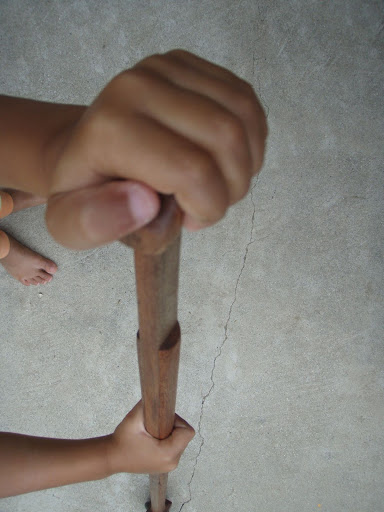
This was my first paddle... built using the top half of a snapped carbon fiber windsurfing mast for the shaft, along with a hand-shaped end-grain balsa blade & handle... vacuum bagged together with S-glass & epoxy... built in 2004 © Jeffrey Kirk Casper



Subscribe to:
Posts (Atom)


